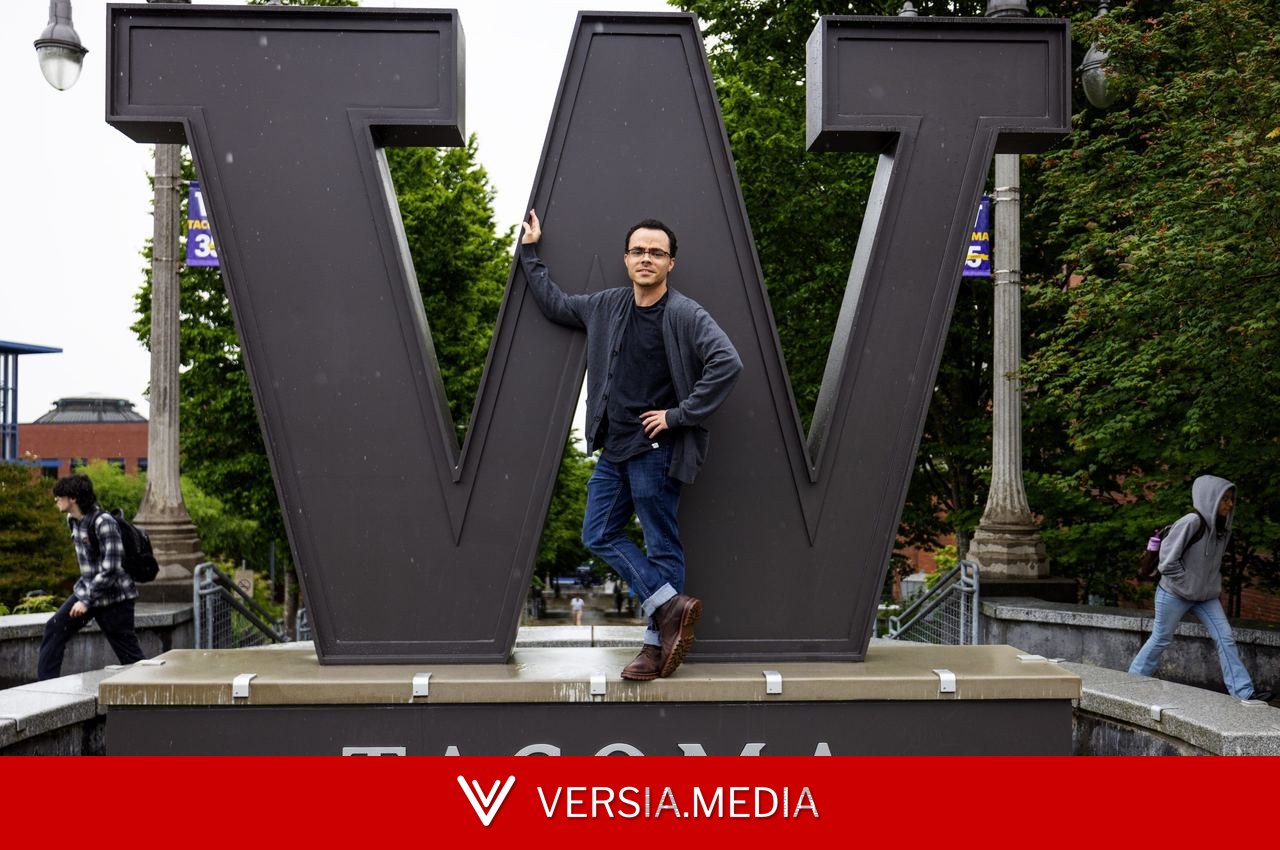
TACOMA, Wash. — Noah Herd developed a passion for computers during his childhood.
When his family’s desktop computer malfunctioned, he taught himself how to repair it. After mastering a programming language, he independently created a video game.
However, it was only later, when he observed technology firms offering six-figure salaries to programmers amid the pandemic, that he began to seriously contemplate a profession in coding.
“It’s cool to build things with software,” remarked Herd, a 30-year-old computer science major and senior at the University of Washington Tacoma. “It requires more creativity than you think.”
Yet, as his graduation later this week draws near, Herd has observed the industry he intends to join undergo a painful series of layoffs. Since the beginning of spring, layoffs have eliminated 30,000 positions at Oracle, another 8,000 at Meta, and — closer to home — Microsoft announced its first-ever employee buyouts.
Higher ed, examined
Our biweekly newsletter delivers deeply reported higher ed stories directly to your inbox.
Δ
“It’s not looking good,” Herd said after participating in an April career fair at UW Tacoma, where, despite the uncertain outlook, technology recruiters still attracted the longest queues. “I want to be a software engineer, and I’m still pushing for that. The reality is I have to pay rent.”
Software development consistently ranks among the occupations most susceptible to displacement by artificial intelligence over the coming decade, with customer service, graphic design, accounting and data entry also topping the vulnerability lists. Entry-level employees and those in Generation Z — individuals currently in their teens and 20s — could also be severely affected, as experts predict AI will most readily automate the kind of repetitive tasks they typically perform when starting their careers.
Last autumn, the unemployment rate for recent college graduates reached its highest level in five years, and recent labor market data indicates a decline in employment for 22- to 25-year-olds in jobs “most exposed” to AI. Handshake, a recruiting and early-career platform, reported that the number of full-time jobs posted on its site fell 2 percent from last year and 12 percent below pre-pandemic levels.
Still, students like Herd, along with economists, are hesitant to attribute the bleak job prospects for the class of 2026 solely to AI, or even primarily. Many students set to graduate this year have already tempered their expectations for securing work in a persistently “low hire, low fire” economy, noting they will now compete with recently laid-off workers and those unable to afford retirement. Labor experts indicate AI has not yet significantly eroded entry-level or white-collar jobs, even as the technology introduces more uncertainty into an already tight market.
Meanwhile, colleges have also attempted to keep up with the rapid changes. Many have integrated AI into their career services, and counselors routinely advise students to learn how to utilize the technology to gain a competitive advantage. They also emphasize the importance of networking and soft skills — such as communication and critical thinking — that AI cannot easily replicate.
“Technical skills may come and go, change and evolve. We’re not teaching the same things in agriculture that we did 25 years ago,” stated John Woods, provost and chief academic officer at the University of Phoenix. “But we are still teaching judgment, critical thinking, teamwork.”
At the same time, some advisers and students expressed concerns that AI could reinforce existing inequalities, allowing the wealthy and well-connected to secure the best, and perhaps only, jobs remaining for humans to fill.
“The effects of AI on labor markets are obviously evolving as we speak,” said Steven Durlauf, a University of Chicago economist who studies human capital and wealth inequality. Young workers “lack clarity about the world they’re entering, and when you don’t know all the probabilities, people tend to assume the worst.”
Related: Become a lifelong learner. Subscribe to our free weekly newsletter featuring the most important stories in education.
Durlauf and other labor market experts note it is challenging to separate AI’s influence on jobs from a multitude of other economic disruptions in recent years: the hiring surge by major tech firms during the pandemic, only to later reverse course; the Trump administration’s significant cuts to the federal workforce and its war in Iran; and growing concerns about inflation, including high housing and healthcare costs.
At the UW Tacoma job fair, numerous computer science majors, including Herd, waited in two long lines to speak with Anshul Bhandari.
Bhandari represented Infoblox, a private cloud computing company, and was recruiting for both internship and full-time positions — including software, engineering, finance and product security. The company already uses AI bots instead of humans to conduct initial interviews with job applicants and has shifted much of its actual programming to AI.
“I see AI as an enabler, not job killer,” he said. “A third of our code is written by AI, but we still need humans. We still need human oversight — at least for the foreseeable future.”
Students shared a variety of perspectives on their job prospects. Laura Cortez, a junior studying mechanical engineering, said she could not attribute her hiring difficulties to a single cause. She recently applied to over 200 jobs and received responses from only a few employers — all rejections.
“I would blame the bad economy, and so many students versus not many jobs out there,” Cortez said.
Cortez did not see much threat to her line of work from AI just yet. She suspected the technology mainly assisted recruiters in filtering resumes, with some eliminating candidates who did not include certain keywords or skills. Some students, Cortez added, have already discovered tricks to bypass those AI scans, such as using hidden or white text on their resumes.
Ibadat Sandhu, a computer science major, hopes to work in cybersecurity. At least in her chosen field, the 22-year-old has observed more recruiters who now require two to three years of experience for entry-level positions.
“Even with internships, they’re getting more specific with what they want from students,” said Sandhu. “I don’t even have four years here [at college] yet. Where do I get that experience?”
Monika Rani hopes she can find work in finance before AI eliminates most jobs in the sector. The 35-year-old recently relocated from Pakistan to pursue a master’s degree in accounting at UW Tacoma and has read articles about the uncertain labor market.
“I think my job is secure,” she said. “We still need humans to double check and oversee AI. It’s useful now, but still contains errors. It’s not 100 percent.”
Young workers could be forgiven for growing weary of receiving mixed messages.
Following a flat 2025, hiring for college graduates should actually increase this year — especially in the information and engineering services industries, along with trade and construction, according to a spring job outlook survey from the National Association of Colleges and Employers, or NACE. Manufacturing and utilities top the list of industries that will decrease hiring. A full third of employers told NACE that they will make new hires, while 11 percent plan to decrease hiring.
And although a majority of employers said they are not yet looking for AI skills on resumes, the respondents indicated that an average of 35 percent of their entry-level jobs do require some proficiency in the technology.
Nearly 3 in 5 employers also said they are assigning AI-related work to interns. “We’ll continue to see a lot more of that,” said Mary Gatta, NACE’s director of research and public policy.
She also noted that employers will continue to move toward what is known as skills-based hiring. This recruiting method is designed to consider a candidate’s actual abilities and competencies, rather than relying on traditional credentials like degrees, GPAs or past titles.
Δ
Back in 2019, close to three-quarters of recruiters screened candidates or only scheduled interviews based on a minimum grade-point average in school. Now, less than half of employers use GPA as a screening tool, according to previous NACE research. Instead, 70 percent report using skills-based hiring for entry-level hires.
Gatta said it is important for college graduates — most of whom have never heard of skills-based hiring — to translate skills they learned with faculty on research or in student clubs onto a resume.
“Employers don’t want them to list ‘critical thinking’ or ‘teamwork.’ They want candidates to explain what that means and provide examples when that was really important and useful,” Gatta said. “That’s helpful for students in all majors, even in computer science.”
Jonathan Wright, director of career services at the College of Southern Nevada, said the rapid introduction of AI in the workplace has only reinforced his long-standing advice that students pursue additional training — whether through externships, certificates or formal degrees — to make their resumes stand out.
Now, however, additional education might mean training on how to work with AI agents.
“Employers still need the humans to manage all these AI tools,” he said. “The human element is still there. Stop running from the technology. Embrace it, and add it to your tool belt.”
On whether AI will worsen the existing digital divide, Wright said he was an optimist: “Instead of trying to figure it out on your own or doing your best without a mentor, AI can give you some steps and tools. You at least have a starting point now.”
Not everyone shares his optimism.
Amanda Figueroa, associate vice chancellor for social mobility at UW Tacoma, noted that employment opportunities and outcomes are already stacked against certain workers, such as Black women. Research from NACE has shown that female, Black, Hispanic and first-generation college students are less likely to obtain paid internships, which can lead to well-paid entry-level positions and offer a chance to meet mentors.
If AI makes it even harder for students to get internships and entry-level work, Figueroa said, it is very likely students will need to rely even more on social connections and interpersonal skills to secure job opportunities. “That risks reinforcing the good old boys’ network,” she said.
The weekend before finals in early June, Herd said he had mixed feelings as commencement approached, proud to earn his degree but scared about the future.
He has set himself a deadline of six months to find a job in computer science. If that does not happen, he said he will consider joining the military.
“I really don’t want to do that,” he said, “but I need to be able to feed myself.”
Contact staff writer Neal Morton at 212-678-8247, on Signal at nealmorton.99, or via email at morton@hechingerreport.org.
This story about AI and the job market was produced by The Hechinger Report, a nonprofit, independent news organization focused on inequality and innovation in education. Sign up for the Hechinger newsletter.
Read More
Strong early math skills equal later algebra success
The biggest expansion of federal scholarship money in 50 years is at hand — and almost nobody is ready for it
Lessons from the first state in the nation to offer universal child care
Was this story helpful? Leave a tip to support your education reporters.
The Hechinger Report is a nonprofit newsroom powered by reader support
Republish This Story
Republish our articles for free, online or in print, under a Creative Commons license.
Republish this article
This work is licensed under a Creative Commons Attribution-NonCommercial-NoDerivatives 4.0 International License.
We offer all nonexclusive stories under a noncommercial Creative Commons license. You are allowed to repost or reprint our stories as long as you use the guidelines below. See here for more details. If you have questions or would like to discuss commercial use, please contact us. If you would like to republish the photos that accompanied this story, please contact us.
by Neal Morton, The Hechinger Report June 9, 2026