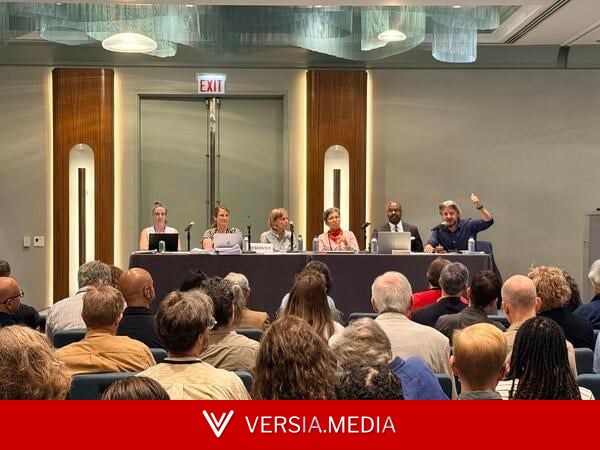
Todd Wolfson (right) speaks during a panel at the biennial AAUP meeting in Chicago.
Kelly Benjamin
CHICAGO—In numerous respects, the American Association of University Professors’ biennial gathering felt akin to a political command center. As thunderstorms and powerful winds raged outdoors, the objective inside the Hyatt Centric Chicago was evident: Higher education is facing assaults, and the AAUP needs to go beyond protecting faculty under threat and intensify its offensive through more efficient organizing, enhanced political engagement, and more robust labor initiatives.
The five-day event, held from Wednesday through Sunday last week, combined elements of a conference and a business meeting, and had considerable material to address since President Donald Trump assumed office for his second term. The two years since the previous biennial meeting “have felt like a decade for higher ed workers,” AAUP president Todd Wolfson informed Inside Higher Ed.
“Trump and his administration have set their sights on higher ed for attack… and we need to devise a way to build a cohesive response that is strong, that safeguards us at the campus level, that forges the alliances and the power needed to address this moment—not just defensively against the Trump administration, but also with a forward-thinking perspective,” Wolfson stated. “There is work ahead, but I believe morale is high and people are energized.”
IU Professor Investigated for Graphic About White Supremacy Loses Job
The Question Haunting the Vanderbilt/Wash U Report (opinion)
Professors Say Vanderbilt Report Misrepresents Their Work
Presenters anchored thematic discussions of the most significant dangers confronting faculty—assaults on academic freedom, the weakening of tenure, and the dismantling of shared governance—with personal accounts of professors under fire. A television screen adjacent to the reception desk continuously played “faculty on the front lines” videos featuring former Texas A&M University instructor Melissa McCoul, former Texas State University professor Tom Alter, and former San José State University professor Sang Hea Kil, among others. Attendees wore pins reading “Reinstate the Fired Six,” referencing the six Virginia State University faculty members who were abruptly dismissed in December without formal notice or due process.
One of the “fired six,” agricultural researcher Vitalis Temu, participated in a roundtable discussion about his ordeal. North Carolina AAUP chapter president Belle Boggs outlined plans to rally behind Kiran Asher, a women’s, gender, and sexuality studies professor who was denied a tenured appointment by the UNC Board of Trustees.
Many of the smaller conference sessions comprised strategy meetings where faculty learned how to organize effectively, run campaigns, and oversee their unions. Attendees were instructed on how to assist colleagues during disciplinary proceedings; implement a swift, strategic media response to campus incidents; and communicate with union members regarding bargaining updates.
Speakers frequently referenced Texas Senate Bill 37, which terminated shared governance at the state’s public institutions when it took effect in September. Brian Evans, former president of the Texas AAUP chapter, began his lunchtime briefing on the state’s assault on academic freedom by telling the audience, “Let me be very clear: It’s really bad in Texas.” Texas AAUP membership has grown significantly over the past few years; the state conference has added 30 new chapters in the last 30 months, Evans noted.
SB 37 was also discussed during a historically Black colleges and universities roundtable, where representatives from HBCUs nationwide spoke about shared governance, DEI, and organizing on predominantly Black campuses.
“When we talk about diversity, we’re not just talking about compositional diversity. Even when we have compositional diversity—[which is] who is at the table—who is being listened to?” Pamela Kennebrew, a psychology professor and chair of the human services department at Lincoln University, told the audience. “We can’t just replace the colors of the chairs—we have to start valuing what people are saying.”
During the business segment of the meeting, the association unanimously approved a set of seven resolutions. Collectively, the resolutions “will define how we organize, what we fight for, and how we act—on our campuses, across the sector, and in the broader struggle for democracy and public good,” according to a handout distributed to conference attendees. Each of the seven plenary sessions throughout the conference focused on one of the resolutions.
The resolutions signify a shift “from advocacy to power,” per the handout. Since his election as president two years ago, Wolfson has urged the AAUP to become more assertive in confronting political challenges.
“I want faculty and others who are here to leave here recognizing that for us to transform our situation—whether it’s our situation in our classrooms, in our departments, on our campuses, in our states or nationally—we have everything we need to do it,” Wolfson said. “We can play a role in transforming democracy in this country.”
Cited Professors Say the Vanderbilt Report Misrepresents Their Work
Colleges Backtrack on Pride Month
What Do We Know About Who Isn’t Reporting Race on College Applications?