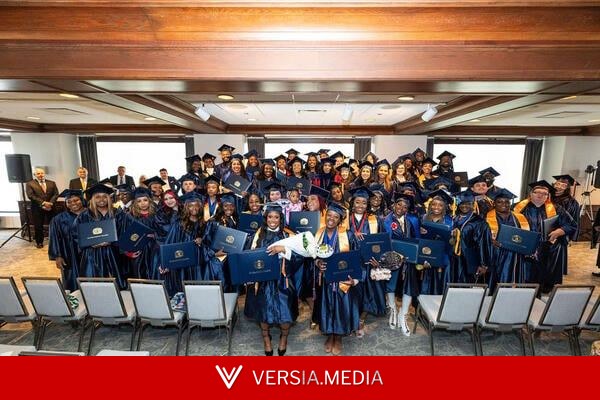
Generations College’s Single Parent Scholarship program covers remaining tuition after grant aid, enabling recipients to earn an associate degree at no cost.
Generations College
When Marissia Simmons left college in 2016 to look after her ailing father, she believed she was merely pausing her education.
Instead, her life fell apart. Within less than a year, Simmons lost her sister, her aunt, and then her father. At age 24, she found herself dealing with immense grief and uncertainty about what lay ahead.
Then she discovered she was pregnant.
IU Professor Investigated for Graphic About White Supremacy Loses Job
The Question Haunting the Vanderbilt/Wash U Report (opinion)
Professors Say Vanderbilt Report Misrepresents Their Work
Following the birth of her daughter, Tzipora, Simmons spent years in survival mode, holding jobs in fast-food restaurants and warehouses while raising her child largely by herself.
“I was trying to take care of my daughter and myself, just trying to figure out where I was going with my life,” Simmons said. “Life was kind of mundane. There was nothing showing for me. I felt stuck.”
That’s when Simmons, now 32, stumbled upon a Facebook post about Generations College’s Single Parent Scholarship program, which covers remaining tuition after grant aid, allowing recipients to earn an associate degree at no cost.
She applied, and it unlocked a new path forward.
“I’m glad I received [the scholarship]. It pushed me to think of possibilities I never imagined for myself,” Simmons said. “It really got me to a place of discipline, owning up to my shortcomings and trying to find purpose in myself.”
Single parent scholarship: For students like Simmons, the expense of returning to college goes well beyond tuition. Childcare, transportation, and the challenges of raising a child alone can make higher education seem unattainable.
To tackle these obstacles, Chicago’s Generations College introduced its Single Parent Scholarship program in 2020 after college leaders observed childcare becoming an increasingly frequent hurdle for student parents. Nearly two million undergraduate students in the U.S. are single mothers, according to the Institute for Women’s Policy Research.
Available to full-time, Pell Grant–eligible students who are single parents, the scholarship covers up to $3,500 per semester. To maintain eligibility, students must keep a cumulative GPA of at least 2.5.
Demand has risen steadily since the program’s inception. This year alone, Generations College granted nearly 90 scholarships.
Cited Professors Say the Vanderbilt Report Misrepresents Their Work
Colleges Backtrack on Pride Month
What Do We Know About Who Isn’t Reporting Race on College Applications?
Chancellor of Generations College Grace Alexis noted that the institution serves a large number of adult learners, many of whom juggle school, work, and family responsibilities. Over half of the college’s student parents are raising their children alone, and the scholarship has become one of the institution’s largest financial aid initiatives.
“We just wanted to provide them with a sense of hope that, ‘Yes, you too can still obtain your college degree, despite the fact that you have all of these other obligations,’” Alexis said. “It takes everything from the parent to make it work. They sacrifice themselves, they sacrifice their education, they sacrifice their lifestyle in order to provide food, shelter and the necessities for their children.”
Challenging assumptions: Alexis said the program’s influence goes beyond helping students afford college. Scholarship recipients have also demonstrated increased persistence, and retention has risen by more than 20 percent.
The program has also drawn a diverse student body, Alexis said, challenging common stereotypes about who single-parent students are and the obstacles they encounter while pursuing a degree.
“A lot of the time people think a single parent is just a high schooler who got pregnant and now they’re an unwed mother,” Alexis said. “No, it’s not just them. That’s why this population has grown so much, and that’s why it deserves the attention that we’re giving it.”
“Imagine how many divorced people there are out there. It’s more than 50 percent now, and a good number of those people have children,” she added. “The one group that doesn’t get enough attention is the growing number of single fathers.”
Alexis said the scholarship aligns with the college’s broader mission.
“We believe that through education there is upward mobility—economically, socially and educationally,” Alexis said. “If we’re able to educate parents, then we are impacting an entire generation of people.”
It requires a community of educators, staff, and faculty who understand the complexities of supporting student parents—especially single parents—to help those students thrive, she added.
“It’s just recognizing that this group is truly different, but at the same time has the ability to make a huge difference, not just in their workplace, but in their entire community,” Alexis said. “If policymakers would be willing to take a closer look at this group—for who they are, what they bring to the table and what they need—they would make policy that is more supportive of the single-parent population.”
A mother’s resolve: Now in her third semester, Simmons is studying entrepreneurship and has maintained a 4.0 GPA, continuing a journey she once believed was beyond her reach.
Her drive to keep moving forward is her daughter, who has level 2 autism. Simmons said caring for a child with extra needs is not entirely new to her; her late sister had cerebral palsy, which taught her patience, empathy, and the importance of meeting people where they are.
She learned “to respect those who have those kinds of conditions and to say, ‘They need love just as much as anybody else,’” Simmons said. “What can I do to push myself financially enough to really provide for me and [Tzipora]? It’s really a soul-searching moment for me to understand the love she needs and the love I give myself as well.”
As she continues working toward her degree, Simmons hopes her daughter is learning from watching her return to college after years away. She wants her to know that setbacks do not define a person’s future and that there is always a way forward.
“I can’t wait for everybody to come to my rescue. I can’t really expect everyone to hear my cries or my sorrows all the time,” Simmons said. “Being in this college now, there are people who see my potential, they see what I’m doing. I’m striving to do more and more.”
“I’m still growing as a person, and this is the steadiest place for me to really push forward, and hopefully by the end of the year I can graduate,” she said.
Get more content like this directly to your inbox. Subscribe here.