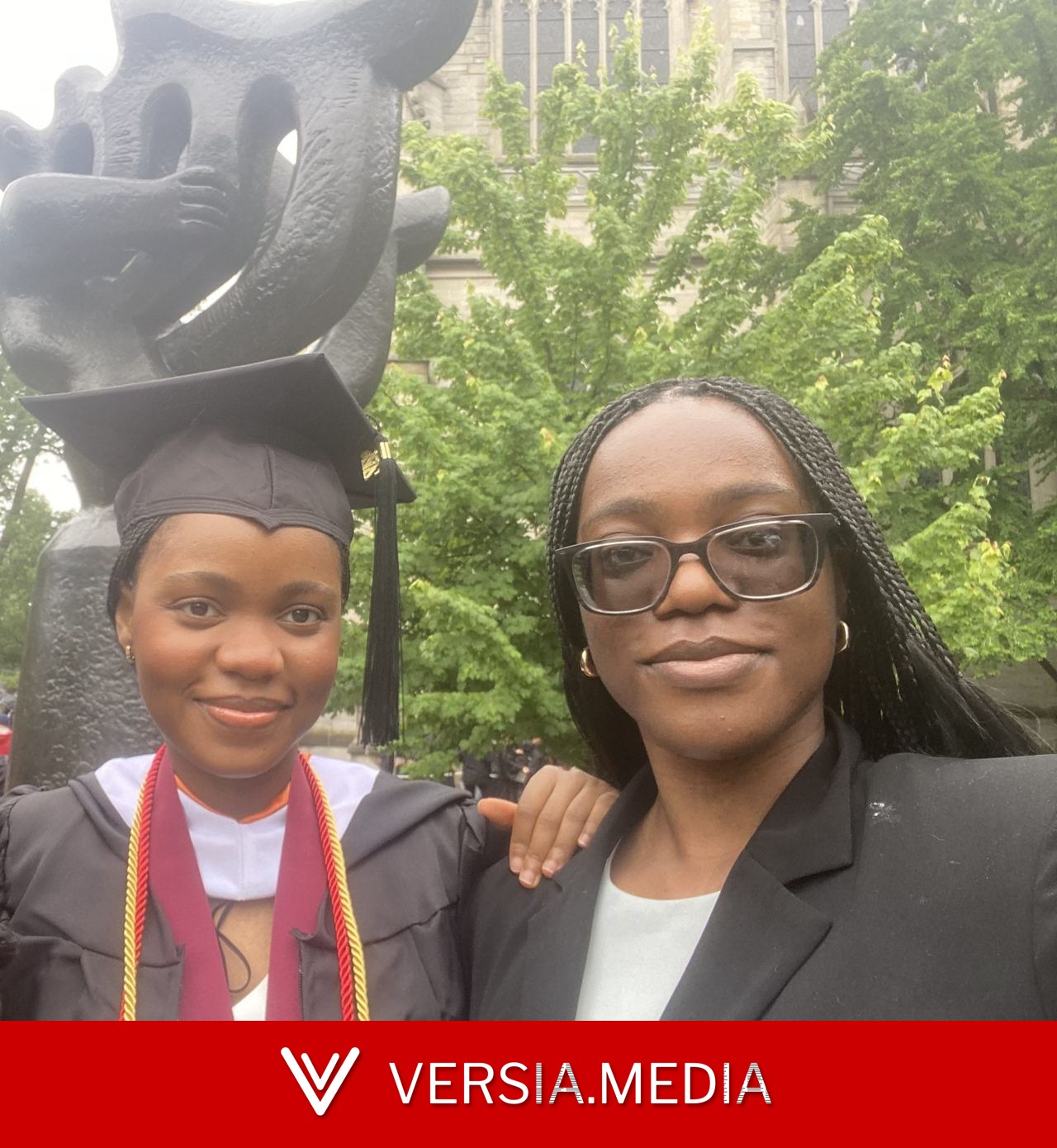
As young sisters growing up in Las Vegas, we lacked the vocabulary to describe our fascination with science. For Angel, it started as an early preoccupation with questions about health and equity: Why do certain individuals fall ill while others remain healthy? Why are some communities disproportionately affected? Why isn't a solution always available?
For Lisa, it was Marvel's comic-book character Iron Man on our computer screen that sowed the seeds of innovation and a desire to assist others.
At that time, our interests were far removed from a reality where much of our daily existence was in a state of pandemic uncertainty. In 2021, when Lisa was 13 and Angel was 17, shifting family dynamics introduced unpredictability and instability into our lives. Throughout it all, our passion for science became a constant anchor.
Science not only embodied our passions and aspirations but also became one of the few areas where effort, curiosity, and persistence consistently yielded results. Later, immersive STEM (science, technology, engineering, and math) experiences opened doors for us, and we are eager to help open those same doors for others. That is why we wish more students could engage in "real science" at an early age, just as we did by participating in the nation’s oldest summer STEM program.
Higher ed, examined
Our biweekly newsletter delivers deeply reported higher ed stories directly to your inbox.
Δ
Angel attended virtually during the pandemic, studying biochemistry. Lisa studied biochemistry in person at Purdue University. Being part of these programs gave both of us genuine access to serious research for the first time, working alongside U.S. and international students from around the globe.
Related: A lot goes on in classrooms from kindergarten to high school. Keep up with our free weekly newsletter on K-12 education .
We weren’t merely following instructions. We were designing experiments and solving problems collaboratively with our peers. When we conducted research, it taught us more than just lab techniques. It showed us that our background and circumstances do not preclude us from performing our own world-class research. Not enough people understand that STEM extends beyond memorizing facts. It is far more expansive. Working in STEM relies on communication, cooperative learning, and other dynamic competencies.
The confidence Angel gained from researching traumatic brain injury and cardiovascular health strengthened her application to Princeton, from which she graduated in May with a degree in molecular biology.
STEM gave Lisa the confidence to establish her own advocacy and awareness organizations, including one focused on empowering young Nigerian women through mentorship and education and another aimed at teaching teens about diabetes prevention and management.
Related: OPINION: Pathways for future scientists are becoming scarce, threatening a strong and innovative workforce
Real science, we both learned, almost never works perfectly on the first attempt. Most of the time, when things go wrong, what helps is stepping back and recognizing that the issue lies not with your equations or math, but with your assumptions.
Being stuck on a problem is not a sign of failure. It is an indication that you are genuinely engaged in real research. STEM teaches more than just biology, chemistry, or engineering; it teaches students how to collaborate with others and how to navigate the real world.
When people discuss the need for "soft skills" alongside technical expertise, they are referring to habits we both developed as high school students, thanks to the opportunity to conduct actual research. Working with peers to pursue hands-on science for its own sake, rather than merely for a grade or a competition, made us better students, better colleagues, and better people.
Meaningful change can occur before college when students have the chance to genuinely explore STEM beyond a textbook. It fosters understanding, innovation, and humanity.
Related: Just 3% of scientists and engineers are Black or Latina women. Here’s what teachers are doing about it.
The momentum that began with our initial experiences in "real science" is now driving us toward change and advocacy. Our curiosity evolved into the study of biology and chemistry because we realized these are tools that enable you to intervene, not just observe.
Δ
We both have an interest in public health and medicine, because medicine is applied science. Every diagnosis, every medication, every lab result is rooted in biology, chemistry, and data. If we are treating a patient, we don’t just want to know what the guidelines say. We want to understand what is happening at a molecular level and why a treatment works—or doesn’t. That is why we have both chosen to pursue a STEM education.
Lisa plans to study pre-med at Princeton next fall with the goal of pursuing biomedical innovation. After graduation, Angel plans to pursue an advanced degree in public health and medicine at Yale. She recently founded and now serves as president of the Global Health Reform Initiative (GHRI), a U.S.-based nonprofit that advances health equity for underserved communities through global health research, policy, and technology-enabled health care access.
Giving students the chance to address real-world problems, allowing them to fail and regroup, and prioritizing learning through access not only yields results but also cultivates better humans.
Angel Ndubisi recently completed a bachelor’s of arts (AB) in molecular biology at Princeton University. She is the founder of the Global Health Reform Initiative, a nonprofit public health organization. Lisa Ndubisi will attend Princeton University in fall 2026 to study pre-med.
Contact the opinion editor at opinion@hechingerreport.org. This story about Summer STEM was produced by The Hechinger Report, a nonprofit, independent news organization focused on inequality and innovation in education. Sign up for Hechinger’s weekly newsletter.
Read More
STUDENT VOICES: We were STEM-obsessed siblings as children. It shaped our pathway to Princeton and careers
OPINION: America’s regional public universities can still be a bargain in a sea of high priced options
OPINION: In this moment of growing public scrutiny, colleges should invest in faculty to drive student success
Want to write your own Op-Ed?
We consider all submissions under 900 words.
Read our guidelines here.
Was this story helpful? Leave a tip to support your education reporters.
The Hechinger Report is a nonprofit newsroom powered by reader support