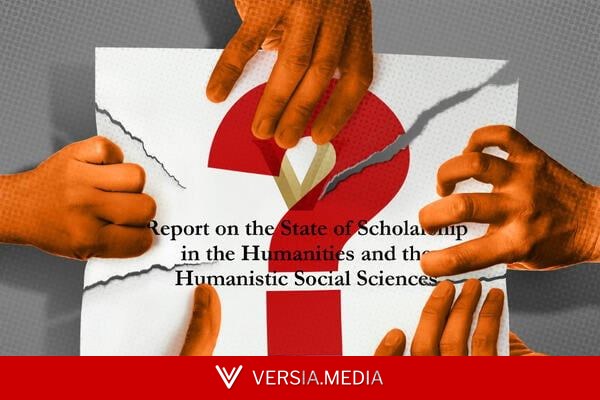
Illustration by Justin Morrison/Inside Higher Ed | autsawin, Davizro and SilverV/iStock/Getty Images
The recently released “Report on the State of Scholarship in the Humanities and the Humanistic Social Sciences” begins with a well-known grievance: that modern academic work is excessively focused on social justice and not sufficiently dedicated to objectivity, rigor, and the search for truth. The report’s writers are cautious in tempering their assertions, yet the primary worry is unmistakable—they fear that political allegiances have increasingly supplanted academic ones.
Numerous reactions to the report (referred to informally as the Vanderbilt/Washington University of St. Louis report) have zeroed in on its methodology, its handling of evidence, and its portrayal of specific fields. These critiques are significant. The American Anthropological Association, for instance, contends that the report draws sweeping conclusions without adequately engaging with the discipline it targets. Others have challenged the report’s dependence on internal evaluations that are not accessible for public review.
Nevertheless, a more profound problem merits attention.
IU Professor Investigated for Graphic About White Supremacy Loses Job
Professors Say Vanderbilt Report Misrepresents Their Work
Will Race-Based Scholarships Survive?
Beneath much of the report lies a nostalgic vision of academia as a domain of apolitical neutrality—a setting where scholars once pursued knowledge devoid of ideological leanings and where disciplinary norms were shielded from social and political pressures. However, that imagined academy was also one from which women and people of color were largely shut out. Even after formal obstacles were eliminated, their viewpoints, life experiences, and intellectual contributions remained sidelined across large portions of the humanities and social sciences.
This background matters because the rise of fields like women’s studies, Black studies, ethnic studies, postcolonial studies, and critical work on race, gender, and inequality did not signify a departure from scholarly inquiry. On the contrary, these fields emerged in reaction to enduring gaps within it. They posed questions that earlier generations of scholars frequently overlooked, since the individuals most impacted by those questions were themselves shut out from the creation of knowledge.
The report consistently treats subjects such as social justice, decolonization, feminism, and antiracism as indicators of a concerning politicization of scholarship. But why should this come as a surprise? As the American academy grew more diverse, the questions scholars examined also evolved. Naturally, feminism became a topic of study. Naturally, race and racism became topics of study. Naturally, scholars grew interested in grasping the structures that shape inequality and exclusion. The viewpoints and experiences of scholars have always shaped what they deemed worthy of exploration. What is different today is that the scholarly community is broader and more representative than at any prior point in American history.
In his book *Lessons Learned: Reflections of a University President*, former Princeton University provost and president William Bowen delves extensively into his role in advancing the coeducation initiative at Princeton and the profoundly significant transformation that process represented for the institution. Although many participants had considered what Princeton could offer women, they did not fully grasp what women would contribute to Princeton. Thus, what started as an effort to open Princeton to women became a reworking of Princeton’s culture, intellectual life, and understanding of excellence.
The same concept applies to knowledge production. When scholars from historically marginalized groups entered academia in substantial numbers, they did not merely bring new faces to existing discussions. They broadened the discussions themselves. They introduced fresh questions, new archives, novel methods, and innovative frameworks for interpreting the world.
To be fair, the report insists that its worry is not about the expansion of scholarly focus to women, racial minorities, and other historically marginalized groups, but rather about the methods used to examine them. Yet this differentiation is less distinct than the report suggests, reflecting an underlying dedication to a more limited idea of what qualifies as valid knowledge and how it is generated. Once academia widened who could engage in knowledge production, it was always probable to widen what counted as significant knowledge and how that knowledge would be pursued. Accepting the former while viewing the latter with suspicion risks preserving the very assumptions that kept these topics on the periphery in the first place.
What the report identifies as a move away from neutrality may instead be proof of the success of academia’s transformation. The humanities have become more responsive to voices once excluded from scholarly consideration. They have expanded our comprehension of what constitutes a legitimate subject of study and whose experiences merit serious intellectual focus.
This development has undoubtedly sparked disagreement. It should. Scholarly fields are most robust when they serve as arenas for lively debate. But it is a mistake to conflate the diversification of inquiry with the abandonment of rigor. The more critical question is whether our concept of objectivity has kept up with the shifting realities of academia itself.
The report asks whether scholarship has become overly political. It never seriously asks whether what it views as political is, in fact, the result of a more inclusive and intellectually expansive understanding of knowledge. Until we confront that question, debates about the state of the humanities will continue to mistake transformation for decline.
Dwight A. McBride is executive director of the Center for the Study of Race, Ethnicity & Equity; Gerald Early Distinguished Professor of African and African American Studies; and professor of English and women’s, gender and sexuality studies at Washington University in St. Louis. He is also past president of the New School in New York City and past provost and executive vice president for academic affairs at Emory University.
Cited Professors Say the Vanderbilt Report Misrepresents Their Work
Colleges Backtrack on Pride Month
What Do We Know About Who Isn’t Reporting Race on College Applications?