Associate Justice Brett Kavanaugh wrote that “the Title IX regulations allowed separate sports teams precisely because of the inherent physical differences between biological men and biological women.”
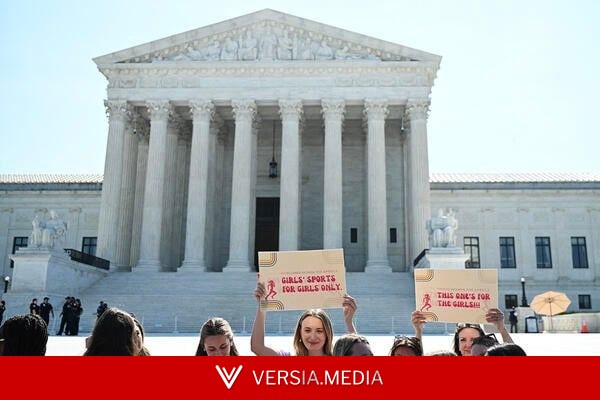
The Supreme Court upheld state laws in Idaho and West Virginia banning transgender girls and women from playing on sports teams matching their gender identity, endorsing prohibitions in more than half the states against transgender inclusion.
“Title IX allows schools to provide separate women’s and men’s sports teams defined by biological sex,” Associate Justice Brett Kavanaugh wrote in the majority opinion , released Tuesday, from the six Republican-appointed justices.
The three liberals filed opinions concurring in part and dissenting in part, saying the majority reached its conclusions prematurely, without allowing lower courts to decide whether the bans are overbroad because they ban trans women who receive gender-affirming care and have never undergone endogenous male puberty.
Kavanaugh wrote that the term “sex” in Title IX and in regulations surrounding it “cannot plausibly be interpreted to refer to anything other than biological sex.”
“The ordinary meaning of the term ‘sex’ at the time of enactment in the early 1970s was biological sex and not gender identity, particularly in the sports context,” Kavanaugh said. “In addition, the Title IX regulations allowed separate sports teams precisely because of the inherent physical differences between biological men and biological women.”
The ruling is the first time in recent years that the high court has weighed in on whether equity laws protect trans students. The Biden administration sought to expand protections for LGBTQ+ students by saying that sex-based discrimination, which is barred under Title IX, includes discrimination based on sexual orientation or gender identity. Several lower federal court judges blocked the Biden Title IX policies; similar to Kavanaugh, they also found the “sex” in Title IX referred to a person’s biological sex.
The court’s ruling likely won’t have an immediate impact on most college trans athletes and institutions, as the NCAA has barred trans women students from competing in the sport in alignment with their gender identity. Still, it’s a blow for trans students and their advocates, and the decision supports the Trump administration, which has worked to roll back trans students’ rights more broadly.
In the immediate aftermath of the court’s ruling, advocates on both sides of the issue weighed in on what the decision means for the future of trans students’ legal protections. Trans rights groups stressed that states with trans-inclusive policies can retain them under the ruling, while groups opposed to trans inclusion said the decision furthers their argument that Title IX is fundamentally about biological sex. As other litigation looms over whether states must ban trans students from women’s sports, this is unlikely the last time the Supreme Court will be asked to weigh in on the issue.
The ruling specifically focused only on athletics, not other aspects of trans inclusion universities must consider, such as housing and bathroom access.
Kavanaugh noted that the ruling doesn’t affect state or institutional policies that currently allow trans women to compete on girls’ and women’s sports teams. “In addition, nothing in this opinion should be interpreted to address or limit participation by biological females on male or co-ed sports teams,” he added.
Nevertheless, groups opposed to trans sports inclusion and other accommodations that recognize transgender individuals’ gender identity said the ruling will be legally useful.
“For those 23 states that have not enacted laws that protect women’s sports, you are out of legal excuses,” Bob Eitel, president of the Defense of Freedom Institute for Policy Studies, said in a statement. “It is now imperative that you follow the lead of West Virginia and Idaho and take immediate steps to fulfill Title IX’s promise of ensuring female athletes can compete on a level playing field.”
Paul Zimmerman, a senior counsel at the Defense of Freedom Institute, told Inside Higher Ed in an interview that the ruling leads to the question “What does Title IX require?” He said it’s “pretty clear” from the majority opinion that “this is a zero-sum game in the case of sports—you only have so many spots on a team; you only have so many spots on the podium.”
“Harms accrue to women and girls participating in sports when they’re forced to participate against biological males,” Zimmerman said.
Elana Redfield, federal policy director at the Williams Institute, a gender identity and sexual orientation research center at the University of California, Los Angeles, School of Law, said it’s necessary to monitor further litigation to see where this leads.
The justices in the majority didn’t “foreclose the alternate interpretation of Title IX, which is to say that it would allow for inclusion, or even require it,” Redfield said. She added that there’s an outstanding constitutional question of whether a requirement to receive federal funding, such as complying with Title IX, can undermine state-level protections for trans people.
Redfield, though, said the Trump administration “will argue this case is dispositive, meaning this case says they win.”
Trump posted on social media Tuesday that the ruling “takes that ridiculous situation off the table!!!” The Education Department posted, “Glad everyone is on the same page now,” and “Judge me all you want, but at least I don’t need the Supreme Court to tell me the difference between a boy and a girl.”
Education Secretary Linda McMahon said in a statement that the ruling “cements” the administration’s Title IX reforms.
“This is a tremendous victory, and we look forward to ensuring that every educational institution in America abides by the law of the land,” McMahon said. ED spokespeople didn’t provide further clarification Tuesday on what McMahon meant. Her statement also said the ruling affirms states’ rights to “safeguard the integrity of female spaces.”
From State to National Issue
Twenty-seven states ban trans women from participating at some level of athletics, according to lawyers both defending and arguing against such laws. During President Trump’s first term in office, Idaho became the first state to pass a law outright banning trans girls and women from participating on women’s teams.
In February 2025, shortly after he returned to the White House, Trump signed an executive order banning trans women from participating in women’s sports and threatening to cut off universities’ federal funding if they allowed them to. The next day, the NCAA announced a policy restricting competition on women’s teams “to student-athletes assigned female at birth only.”
In April 2025, the Education Department’s Office for Civil Rights concluded that the University of Pennsylvania violated Title IX by allowing a trans woman to compete on a women’s sports team—presumably referring to Lia Thomas, who last competed on the swim team in 2022, in accord with NCAA policies at that time.
Although the court’s opinion focuses on athletics, the Trump administration has opened a number of investigations into whether policies that support trans students, such as allowing them to access the bathroom that aligns with their gender identity, violate Title IX.
The court ruled in two long-running cases: Little v. Hecox and West Virginia v. B.P.J. Both center on whether anti–trans athletics participation laws violate Title IX and the 14th Amendment’s equal protection clause. The federal government joined these red states’ attorneys and solicitors general in defending the laws.
Idaho passed its law in 2020. Lindsay Hecox is a trans woman who was nevertheless able to participate in women’s club running and club soccer at Boise State University because she sued that same year and a district court blocked enforcement of the law against her.
In 2024, her lawyers wrote that she tried out for the university women’s cross-country and track teams but didn’t make it, “consistently running slower than her cisgender women competitors.” Her attorneys stressed that her “circulating testosterone levels are typical of cisgender women.”
Hecox’s attorneys opposed the Supreme Court taking up the case, previously writing that it’s “about a four-year-old injunction against the application of [the Idaho law] with respect to one woman, which is allowing her to participate in club running and club soccer.” This past September, her lawyers argued the case had become moot, saying Hecox dismissed her claims and “committed not to try out for or participate in any school-sponsored women’s sports covered by” the state law.
But Idaho’s attorney general argued the case should continue—despite Hecox being the person who filed the case against the state in the first place.
In West Virginia, Becky Pepper-Jackson, then a sixth grader, intended to compete in cross-country and track and field, but she wouldn’t have been able to do so because of a state ban passed in 2021. Her mother sued, and judges blocked enforcement of the Mountain State’s law against the student.
Pepper-Jackson’s attorneys wrote that the sports she’s participated in are noncontact, and that she “has received puberty-delaying medication and gender-affirming estrogen that allowed her to undergo a hormonal puberty typical of girls, with all the physiological musculoskeletal characteristics of cisgender girls and none of the testosterone-induced characteristics of cisgender boys.” They also previously wrote that she participated in postseason shot put and discus, “where her performance is well within the range of cisgender girls.”
Last month, Pepper-Jackson won the Class AAA girls’ state championship in shot put.